




25/02/2026 | Is it a cataract?
February 25, 2026
Podcast: WHAT DOES YOUR DOCTOR SAY?
Episode: Is this a cataract?
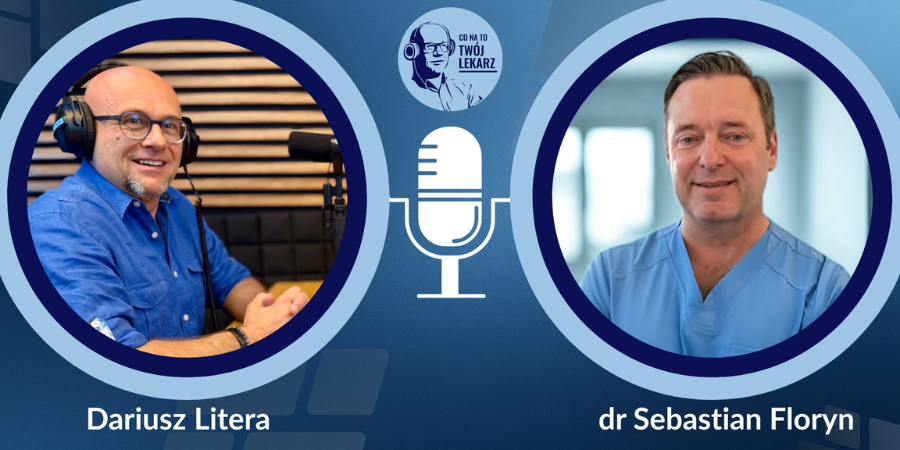
Leading: Dariusz Litera
Guest: Dr. Sebastian Floryn, ophthalmologist
Duration: 15 minutes
Cataracts, or clouding of the eye's lens, are one of the leading causes of visual impairment worldwide, according to the World Health Organization. They are most often associated with old age, but as the specialist emphasizes, they can also affect younger people in certain clinical situations.
In this episode of the WHAT YOUR DOCTOR SAYS podcast, Dariusz Litera talks with ophthalmologist Dr. Sebastian Floryn about the symptoms of cataracts, their causes, treatment options, and what patients can expect after surgery to remove a cloudy lens.
Full podcast transcript
[00:00:00] Introduction
Dariusz Litera:
According to the WHO, cataracts are the leading cause of visual impairment worldwide. Online, we read that it's a disease of the elderly. If someone is barely over fifty, they probably don't have to worry about it. Are you sure? Today, your doctor is ophthalmologist Dr. Sebastian Floryn. Good morning, doctor.
Dr. Sebastian Floryn:
Good morning, Mr. Darek.
[00:00:21] What is a cataract?
Dariusz Litera:
The traditional question – what is a cataract?
Dr. Sebastian Floryn:
A cataract is a condition in which our own lens becomes cloudy. It begins to transmit less light than should reach the retina, resulting in decreased visual acuity.
Dariusz Litera:
Does this cloudiness appear on its own or for any specific reasons?
Dr. Sebastian Floryn:
Generally speaking, lens clouding is a natural part of our lives. However, there are situations that can accelerate this process, even in people much younger than the typical age group.
Dariusz Litera:
So we are all at risk?
Dr. Sebastian Floryn:
We are all at risk of developing lens clouding. The key is understanding the mechanism that leads to this.
[00:01:00] Are "flowing" shadows cataracts?
Dariusz Litera:
When I look to the left and then straight ahead, something floats in front of my eye. Could this be a cataract?
Dr. Sebastian Floryn:
What you're describing is most often a thickening of the vitreous humor, the structure behind the lens. A cataract should be suspected when a patient reports seeing less clearly on television or feels like they can't see other vehicles as clearly as before when driving at night.
Dariusz Litera:
So then we don't move the couch closer to the TV, we go to the ophthalmologist.
Dr. Sebastian Floryn:
I would definitely choose the second option.
[00:01:47] Causes of cataracts
Dariusz Litera:
What are the causes of cataracts?
Dr. Sebastian Floryn:
The first factor is age. Over time, the lens begins to cloud. This most commonly affects people over 60. However, there are other causes as well.
Dariusz Litera:
For example, medical conditions?
Dr. Sebastian Floryn:
Yes. This primarily concerns steroid treatment. People around the age of 40 who have been taking steroids for several years—for example, for rheumatological conditions—may experience a dramatic deterioration in visual acuity.
Dariusz Litera:
And this is a side effect of steroids?
Dr. Sebastian Floryn:
Yes. This is a side effect of treatment, which is also necessary to treat the underlying disease.
Dariusz Litera:
And other causes?
Dr. Sebastian Floryn:
These can be post-traumatic cataracts. For example, hitting the eye with a tennis or squash ball without proper eye protection can lead to clouding of the lens. This process is usually progressive and does not reverse.
[00:03:42] Can cataracts be treated pharmacologically?
Dariusz Litera:
Can we slow down cataracts pharmacologically?
Dr. Sebastian Floryn:
There are drops that are designed to slow down the progression of clouding and may limit it to some extent. However, the only effective way to eliminate the problem of decreased visual acuity in the case of cataracts is surgery.
[00:04:23] Does cataract surgery hurt?
Dariusz Litera:
Surgery sounds scary. Does it hurt?
Dr. Sebastian Floryn:
The patient receives appropriate premedication and is assured of comfort. Procedures are performed under intravenous, intravenous, or retrobulbar anesthesia. The patient is not under anesthesia and is aware of what is happening, but after the procedure, they usually say they expected something worse.
[00:05:03] What is cataract surgery?
Dr. Sebastian Floryn:
The surgery involves removing the cloudy lens and implanting an artificial lens in its place. The goal is to improve the patient's comfort and quality of life, and to enable them to return to their previous activities.
[00:06:11] What are the types of artificial lenses?
Dr. Sebastian Floryn:
The lenses are made of materials that ensure transparency and are compatible with the body. Current technology allows for the implantation of various types of lenses, including those that correct astigmatism.
Before choosing a lens, it's important to talk carefully with the patient and understand their expectations. Not everyone wants to completely give up glasses. In the case of multifocal lenses, it's important to inform the patient that not everyone can adapt to them—just like with progressive lenses.
[00:10:05] What if the patient doesn't accept the lens?
Dr. Sebastian Floryn:
Adaptation usually occurs after 4–6 weeks. In exceptional cases, it is possible to remove the implanted lens and implant a different one, but such cases are rare.
[00:10:55] Recovery after surgery
Dr. Sebastian Floryn:
The procedure is performed using micro-instruments, with very small incisions (approximately 2.2–2.4 mm), which avoids the need for stitches. Healing typically takes 2–4 weeks. Recovery is much less strenuous today than it was 20 years ago.
[00:11:42] Reimbursement by the National Health Fund
Dr. Sebastian Floryn:
Cataract surgery is reimbursed by the National Health Fund (NFZ) when certain criteria are met – visual acuity is 601 TP3T or less. However, there are special situations, such as a significant difference in power between the eyes, that may also qualify for the procedure.
[00:13:02] Do artificial lenses accommodate?
Dr. Sebastian Floryn:
The ability to accommodate is attributed to our natural lens. Currently, premium lenses with multifocal rings attempt to replicate this function as closely as possible, although natural accommodation remains unsurpassed.
[00:13:58] The three most important symptoms of cataracts
Dr. Sebastian Floryn:
The first symptom is a decrease in visual acuity. Furthermore, attention should be paid to light refraction – especially on sunny days – and a decrease in quality of life when we are unable to safely perform usual activities, such as driving or performing work requiring good visual acuity. It's best to confirm this suspicion during a standard ophthalmological consultation.
Key takeaways for patients
- A cataract is a clouding of the natural lens of the eye, leading to a decrease in visual acuity.
- The most common cause is age, but cataracts can also occur in younger people (e.g., during long-term steroid therapy or after trauma).
- The symptoms include primarily deterioration of visual acuity, dispersion of light and a decrease in the comfort of everyday functioning.
- Drops can slow down the process, but the only effective treatment is surgery.
- The procedure is minimally invasive, usually painless, and allows for a quick return to activity.
- The choice of the type of lens should be preceded by a detailed conversation with the doctor about the patient's expectations.
Information about the authors:
Dr. Sebastian Floryn – a specialist in ophthalmology, specializing in the diagnosis and treatment of eye diseases, including cataract surgery.
Dariusz Litera – journalist and creator of a medical podcast WHAT DOES YOUR DOCTOR SAY?, specializing in health communication and patient education.
ATTENTION!
This material is for educational purposes only. It does not replace an individual medical consultation. If you experience any disturbing symptoms or have any concerns about your health, please consult your doctor.
Who we are
In our work, we are guided by the idea of a family doctor who provides the patient with comprehensive care at all times, not only when they are ill. Our mission is to take care of the health of residents on a daily basis. We provide health education and promote prevention.
Copyright © Wrocław 2021 NZOZ Your Doctor Sp. z o. o. All Rights Reserved.
Website created by KomuKoncept: www.komukoncept.pl