


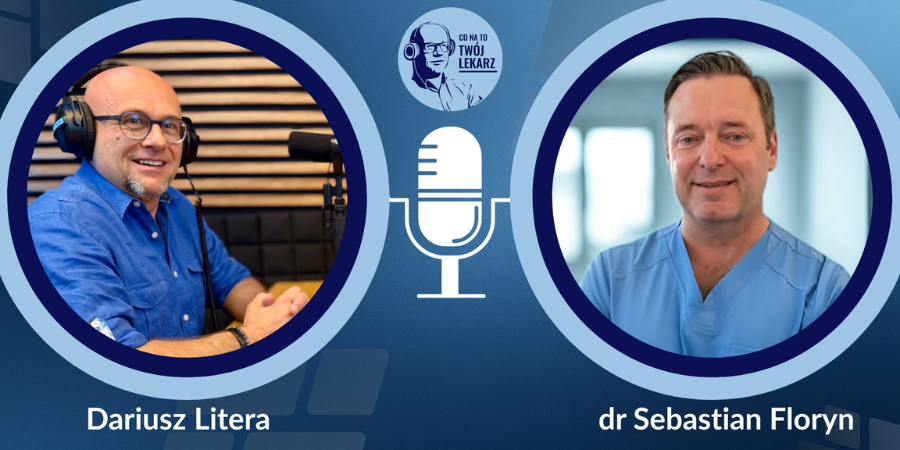


04/03/2026 | Sudden vision loss. When a quick response is key.
March 4, 2026
Podcast: WHAT DOES YOUR DOCTOR SAY?
Episode: Sudden vision loss. When quick response is key.
Leading: Dariusz Litera
Guest: Dr. Sebastian Floryn, ophthalmology specialist
Duration: 13 minutes
Not every vision problem is painful. In ophthalmology, many serious, potentially irreversible conditions are painless, and the only symptoms may be flashes, floaters, sudden visual field loss, or the sensation of a dark spot in front of the eye.
In this episode of WHAT YOUR DOCTOR SAYS, Dariusz Litera talks with Dr. Sebastian Floryn, an ophthalmology specialist, about symptoms that shouldn't be ignored. The expert explains when you should urgently seek medical attention, why time matters in some cases, and what systemic diseases can manifest through eye symptoms.
FULL PODCAST TRANSCRIPT
[00:00:00] Introduction
Dariusz Litera:
Not every vision problem is painful. Sometimes it's just flashes, floaters, or the feeling that something is blocking part of our vision. Many patients wait for a better moment instead of seeing a doctor. However, it's not worth delaying a visit to the ophthalmologist. Want to learn about symptoms where time is of the essence? Find out what your doctor has to say.
Today, your doctor is ophthalmologist Dr. Sebastian Floryn. Hello again, Doctor.
Dr. Sebastian Floryn:
Good morning, Mr. Dariusz.
[00:00:27] What symptoms do patients most often ignore?
Dariusz Litera:
What signals are most often ignored by patients?
Dr. Sebastian Floryn:
The most frequently ignored symptoms that could signal something serious include any kind of large floaters floating in front of the eye. These are black flakes of soot or dark, carbon-like dust that "floats" in front of the eye.
The most serious symptom, however, is a fixed, dark aperture that deprives the patient of the ability to see in certain sectors of the visual field.
[00:00:57] "And then we don't wait anymore"„
Dariusz Litera:
And then we no longer wait for anything.
Dr. Sebastian Floryn:
I always tell patients that if these types of symptoms appear, there is absolutely no point in trying to get a private appointment or arranging a consultation "through connections.".
You need to go to an emergency ophthalmologist because such symptoms may indicate a very serious condition in which time is of the essence.
[00:01:22] Why do patients delay when symptoms are concerning?
Dariusz Litera:
Why do patients wait even though something is bothering them?
Dr. Sebastian Floryn:
If something doesn't hurt, it seems less serious than a symptom that does. And in ophthalmology, the most serious conditions—even those leading to potential vision loss—are often painless.
It's human nature to think, "Maybe this will pass. I'll wait until tomorrow." Logistics often arises as well—lack of transportation, inability to get to a doctor quickly. And so, precious time is lost.
[00:02:12] Why is time so important in ophthalmology?
Dariusz Litera:
Time matters – why?
Dr. Sebastian Floryn:
Many ophthalmological ailments, especially those related to circulatory disorders in the retina, can lead to irreversible changes.
An example is central retinal artery occlusion. The leading symptom is a decrease in visual acuity – to varying degrees, depending on which vessel is occluded and to what extent.
This is a state in which hours count – one, maybe two – when you can still try to reverse the situation.
Dariusz Litera:
After this time, the changes are irreversible?
Dr. Sebastian Floryn:
Most often, yes. We're talking about a blockage of the vessels that nourish the retina.
[00:02:58] When are floaters harmless?
Dariusz Litera:
When are floaters harmless?
Dr. Sebastian Floryn:
Not every floater or spot is necessarily a sign of danger. As we age, the amount of thickening in the vitreous humor increases. This is a natural process.
The vitreous body contains thickenings that may be visible especially against a light background.
However, if thick patches resembling soot or a dark iris suddenly appear, it is a sign that the matter may be serious and requires urgent diagnosis and treatment.
[00:03:40] Flashes in the eye – physiology or threat?
Dariusz Litera:
What about flashes?
Dr. Sebastian Floryn:
Flashes of light are a fairly common symptom. The eyeball is filled with a clear gel called the vitreous humor. With age, the vitreous humor shrinks and begins to separate from the underlying structure.
This can cause traction on the retina—the nerve tissue. Mechanical stimulation of the retina is converted into an electrical impulse, causing the patient to see "sparkles," "stars," or flashes.
This requires a fundus examination after dilating the pupils to assess whether this is a physiological vitreous detachment or whether there is a retinal tear that could lead to detachment.
[00:04:44] When do flashes become an alarm signal?
Dariusz Litera:
Are sudden and persistent flashes a warning signal?
Dr. Sebastian Floryn:
Yes. They don't always indicate anything serious, but if they persist and are accompanied by the sensation of a floating trail of blood, you should see an ophthalmologist immediately.
This may indicate a retinal tear. Laser repair can be performed at an early stage to prevent retinal detachment.
[00:05:40] Visual field defects – what can they mean?
Dariusz Litera:
What about visual field defects?
Dr. Sebastian Floryn:
They can have various origins. One example is amaurosis fugax – a transient, momentary spasm of the retinal blood vessels. The patient reports an episode of visual field narrowing, which resolved.
It may also be a sectoral retinal detachment – the mentioned aperture in front of the eye.
In patients with cardiac diseases, venous or arterial occlusion in the retina may occur, resulting in sectoral visual field loss.
Then, ophthalmological, internal medicine, cardiology and neurological diagnostics are necessary.
[00:06:40] Who is at risk?
Dariusz Litera:
Who is at risk of such changes?
Dr. Sebastian Floryn:
Most often, these are patients with cardiological ailments, obesity, and hypertension.
A problem visible in the eye may be the result of a general illness. That's why regular internal medicine checkups, including cholesterol, blood pressure, and sugar levels, are so important.
Unregulated parameters can lead to dramatic ophthalmological symptoms.
[00:08:22] What does an ophthalmologist see in the retinal vessels?
Dr. Sebastian Floryn:
An ophthalmologist is the only doctor who can see blood vessels live without cutting tissue.
The condition of the vessels in the retina often reflects the condition of the coronary vessels and other vessels in the body.
[00:09:01] Myopia and age – do they increase the risk?
Dariusz Litera:
Should myopia increase vigilance?
Dr. Sebastian Floryn:
Yes. People with severe myopia should have a fundus examination with dilated pupils at least once a year.
Myopic people are more likely to experience degenerative changes in the peripheral retina, which may be the starting point for abrasions and detachments.
Dariusz Litera:
And age?
Dr. Sebastian Floryn:
Older people are more likely to suffer from systemic diseases, which is why the conditions described above are more common in them. However, their occurrence in younger people cannot be ruled out.
[00:10:11] Emergency room or urgent visit?
Dr. Sebastian Floryn:
If you experience a dark spot in front of your eye or a narrowing of your field of vision, you should go to an emergency ophthalmologist as soon as possible.
If only flashes or minor densities appear, this does not necessarily indicate an immediate danger.
However, any radical, sudden decline in visual acuity is an indication for urgent consultation.
[00:11:20] Myths: "If it passed, it was okay"„
Dariusz Litera:
Myth one – if it passed, nothing happened.
Dr. Sebastian Floryn:
Not always. The vessel may be temporarily occluded by embolic material, which then migrates. Vision returns, but the risk of re-occlusion—perhaps permanently—remains.
Dariusz Litera:
The second myth is that it is exhaustion and it will go away on its own.
Dr. Sebastian Floryn:
Persistent "fog" in front of the eye may indicate macular conditions such as retinal membrane or edema. Expecting it to go away on its own isn't always a good idea.
Dariusz Litera:
And "I'll sleep on it and it'll be fine"?
Dr. Sebastian Floryn:
Each situation is unique. However, with a strong family history and severe symptoms, even an overnight visit to the emergency room may be warranted.
[00:12:44] Ending
Dariusz Litera:
Dr. Sebastian Floryn, an ophthalmology specialist, said in the podcast WHAT YOUR DOCTOR SAYS. Thank you very much, Doctor.
Dr. Sebastian Floryn:
Thank you very much too.
Key takeaways for patients:
- The sudden appearance of a dark aperture or narrowing of the field of vision requires urgent consultation at an emergency ophthalmologist.
- In the case of retinal artery occlusion, hours count.
- A sudden, significant decrease in visual acuity is an indication for immediate diagnosis.
- Persistent flashes, especially those accompanied by a "blood trail," may indicate a retinal tear.
- Systemic diseases (hypertension, lipid disorders, diabetes) increase the risk of serious ophthalmological complications.
- People with high myopia should have their eye fundus examined regularly.
- The disappearance of a symptom does not mean that the problem did not exist.
Information about the authors
Dr. Sebastian Floryn – ophthalmology specialist, clinical practitioner, dealing with the diagnosis and treatment of acute and chronic eye diseases.
Dariusz Litera – journalist and creator of a medical podcast WHAT DOES YOUR DOCTOR SAY?, dealing with health communication and patient education.
ATTENTION!
This material is for educational purposes only. It does not replace an individual medical consultation. If you experience any disturbing symptoms or have any concerns about your health, please consult your doctor.
Who we are
In our work, we are guided by the idea of a family doctor who provides the patient with comprehensive care at all times, not only when they are ill. Our mission is to take care of the health of residents on a daily basis. We provide health education and promote prevention.
Copyright © Wrocław 2021 NZOZ Your Doctor Sp. z o. o. All Rights Reserved.
Website created by KomuKoncept: www.komukoncept.pl