




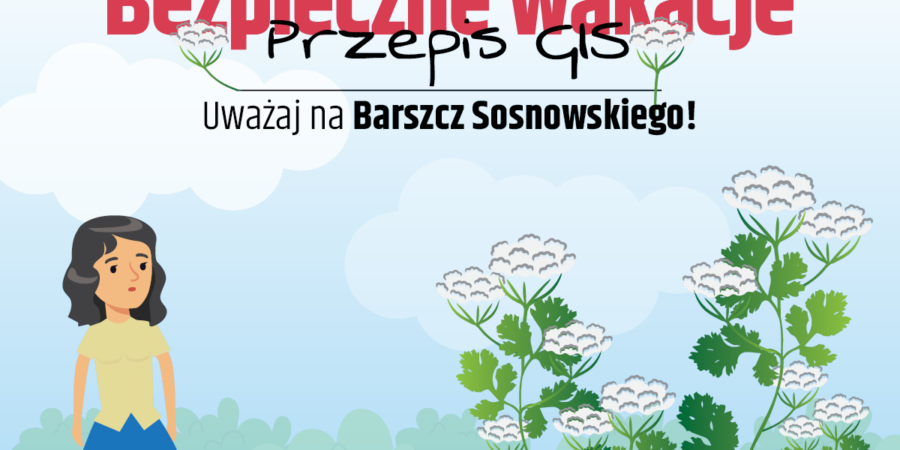


Safe holidays. Experts warn against Sosnowsky's hogweed
13 Jul 2020
Vacations are a time for hiking, walking and outdoor recreation. Contact with nature has a beneficial effect on our health, provided that we are sensible and avoid dangers. It warns against one of them on its pages Chief Sanitary Inspectorate. It's about a dangerous plant – Sosnowsky's Hogweed, which holiday travelers may encounter on their way.
Hogweed is an invasive, stinging plant that occurs throughout Poland. Interestingly, it was brought from the Caucasus as a fodder plant. Due to the content of toxic substances, it was abandoned for use in agriculture and currently in Poland the plant is subject to a legal ban on cultivation, reproduction and sale.
Where can you find Sosnowsky's Hogweed?
– meadows,
– arable fields,
– on the roads,
– along the banks of rivers, lakes, streams,
– in gardens, parks and forests.

What does Sosnowsky’s hogweed look like?
The plant is characterized by umbellate white inflorescences and large leaves. It reaches a height of up to 4 m. Its stem is approximately 10 cm in diameter. The stems and leaves of Sosnowsky's hogweed contain characteristic hairs that produce a toxic substance.

What are the risks of contact with Sosnowsky's hogweed?
Compounds contained in the juice and secretion of the glandular hairs of Sosnowsky's hogweed bind to the skin under the influence of UVA and UVB rays, causing second and third degree burns. Within 24 hours, symptoms intensify in the form of skin redness and blisters with serous fluid. The inflammation lasts for about 3 days, and the irritated areas remain sensitive to ultraviolet light for up to several years.
In addition to burns, the compounds contained in Sosnowsky's hogweed can cause:
– respiratory tract irritation,
– nausea,
– vomiting,
– headaches,
– conjunctivitis.

First aid for Sosnowsky's Hogweed burn:
Step 1
Wash skin immediately and thoroughly with plenty of soap and lukewarm water.
Step 2
Avoid the sun for at least 48 hours (ultraviolet radiation increases inflammation and the risk of scarring).
Step 3
If burn symptoms appear, be sure to consult a doctor!

GIS APPEALS:
You can always check the location of Sosnowsky's hogweed in Poland in an online database, which currently has nearly 3,000 locations. If you spot Sosnowsky's hogweed, report it to the 24-hour emergency number 986 of the Municipal Police!
/source: www.gis.gov.pl/
Our partners


Who we are
In our work, we are guided by the idea of a family doctor who provides the patient with comprehensive care at all times, not only when they are ill. Our mission is to take care of the health of residents on a daily basis. We provide health education and promote prevention.
Copyright © Wrocław 2021 NZOZ Your Doctor Sp. z o. o. All Rights Reserved.
